
PROOF OF EXPERIENCE
Published research & scientific credentials.
Selected peer-reviewed publications demonstrate a background in structure-based drug design, molecular docking, medicinal chemistry, and experimental pharmaceutical research.
FEATURED PUBLICATION
A published molecular docking study
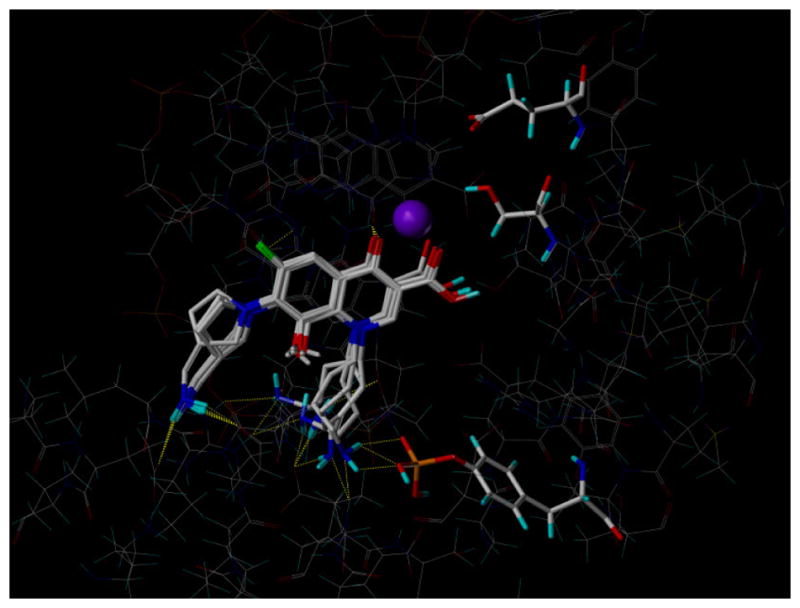
Our 2018 fluoroquinolone study combined docking-based interaction hypotheses with synthesis and experimental testing. The original work used the SYBYL-X docking suite.
Representative docking explored whether extended N-1 substituents could approach the active-site tyrosine in a topoisomerase–DNA complex. The published figure shows six predicted poses of a quinolone derivative.
BIBLIOGRAPHY
Selected peer-reviewed publications
Seven selected articles span computational and structure-based investigations, medicinal chemistry, drug mechanisms, and molecular research.
- 2018
Towle, T. R., et al. (2018). Design, synthesis, and evaluation of novel N-1 fluoroquinolone derivatives: Probing for binding contact with the active site tyrosine of gyrase. Bioorganic & Medicinal Chemistry Letters, 28(10), 1903–1910.
DOI: 10.1016/j.bmcl.2018.03.085 ↗Computational docking and experimental medicinal chemistry.
- 2014
Drlica, K., Mustaev, A., Towle, T. R., et al. (2014). Bypassing fluoroquinolone resistance with quinazolinediones: Studies of drug–gyrase–DNA complexes having implications for drug design. ACS Chemical Biology, 9(12), 2895–2904.
DOI: 10.1021/cb500629k ↗Drug–target interaction studies with computational components.
- 2019
Lentz, S. R. C., Chheda, P. R., Oppegard, L. M., Towle, T. R., et al. (2019). The C7-aminomethylpyrrolidine group rescues the activity of a thio-fluoroquinolone. Biochimie, 160, 24–27.
DOI: 10.1016/j.biochi.2019.02.002 ↗Medicinal chemistry and structure–activity investigations.
- 2019
Oppegard, L. M., et al. (2019). Novel N-1 substituted fluoroquinolones inhibit human topoisomerase I activity and exhibit anti-proliferative activity. Investigational New Drugs, 37(2), 378–383.
DOI: 10.1007/s10637-018-0666-x ↗Investigational drug discovery and biochemical evaluation.
- 2016
Oppegard, L. M., et al. (2016). Fluoroquinolones stimulate the DNA cleavage activity of topoisomerase IV by promoting the binding of Mg²⁺ to the second metal binding site. Biochimica et Biophysica Acta, 1860(3), 569–575.
DOI: 10.1016/j.bbagen.2015.12.019 ↗Mechanistic studies of drug–enzyme interactions.
- 2013
Towle, T., Chang, I., Kerns, R. J., and Bhanot, P. (2013). Chemical probes of a trisubstituted pyrrole to identify its protein target(s) in Plasmodium sporozoites. Bioorganic & Medicinal Chemistry Letters, 23(6), 1874–1877.
DOI: 10.1016/j.bmcl.2013.01.010 ↗Chemical probes and target identification.
- 2008
Tureček, F., et al. (2008). Hidden histidine radical rearrangements upon electron transfer to gas-phase peptide ions: Experimental evidence and theoretical analysis. Journal of the American Chemical Society, 130(44), 14584–14596.
DOI: 10.1021/ja8036367 ↗Molecular mechanisms and theoretical analysis.
DOCTORAL RESEARCH
University of Iowa · 2013
Towle, T. R. Synthesis of novel fluoroquinolone derivatives toward understanding aspects of function. Doctoral dissertation, University of Iowa.
View dissertation repository ↗CONTINUING WORK
Current computational research
Ongoing research explores reproducible molecular-modeling, docking and molecular-dynamics workflows. New original figures and technically reviewed case studies will be added as publication and disclosure decisions permit.
Existing papers demonstrate historical computational research; newer software methods are described separately as current service capabilities.